Sunday, 24 October 2010

Every Coin

Тιδιε xрεcмιнтε ἱ δακрεн.

Every coin have.3sg back.acc.
Every coin has a backside.

I've come up with my first Lurion proverb. It implies that every fortunate event can (but not necessarily must) be accompanied by a catch. When said to someone who is about to buy something or make some sort of deal, it is a warning that he or she must also look at the consequences and make sure it is not a scam; when someone notices that you or your deeds are not perfect, it can be used as a "that's life" apology.

Because the common people do not often use money, a more 'fitting' and of course more vulgar expression has come into existence: 
Тιδιι zωιc ἱ δακрεн. 
It literally means "Every animal has a backside," but "every animal has a behind / an arse" is obviously implied. In this context, the fortunate event is represented by a productive animal, whereas the catch is the feces and indirectly its food consumption.
However, it can also be used to state that everyone is but a human and therefore has his own flaws. It can be chanted whilst rebelling against an arrogant king; it can be exclamated when one is being punished for a mistake.

Tuesday, 12 October 2010

Busy

Єυтιε Καтαᴧυ!

And, ευтιε αнιδαᴧυ!, as I will turn 17 tomorrow. (Yay!) I am not planning on doing anything spectacular; we'll go out for dinner sunday and I've invited some of my friends for some movies and games on monday the 25th (busy schedules, I guess).

Cαφтυ ἁπтιφου ειοрι Cтрeπαн ευмοнει πрοрωнтιαн.

Softness pillow.gen cause.3sg Strepa.acc happiness.dat purr.prt.f.acc.
The softness of the pillow made Streepje purr with happiness.

It was Animal Day last week, and I thought my cats needed and deserved a new scratching post. It goes without saying, they were thrilled to bits. While one was sitting on it, the other thought it was an opportune moment to sharpen her nails and set her claws into her sister's behind; an act that was not much appreciated.

Πрοрοιн is of course an onomatopoeia, as well as мαυαιн ('to meow'). Also, the two Faias in cαφтυ ἁπтιφου have some onomatopoeiic value, I guess.

In spite of all the festivities, I think this might be one of the last Katalus. At least for a while. My other hobbies, gaming and gamemaking, are demanding too much time. I'm really getting a feel for online StarCraft 2, I've got one game to finish, one immense project to continue work on, and another to start. Not to mention the new Call of Duty coming out next month. Posting something weekly has appeared to be too much of a hassle. I might be posting irregularly just the same, but I can not make any promises.

Hail cats!

Tuesday, 5 October 2010

Rrrrrelax

Єυтιε Καтαᴧυ!

I thought the picture I made today didn't cut it, so I cheated and took one I made earlier. Noortje looks much cuter as well.

Єι рωтοрeιc ειδεcεн καδυнцε, δειнυтαι Нοртα тεтαррωнтιαн e οрαрωнтιαн.

If turn.trans.coni.2sg image.acc head.acc-or, appear.3sg Norta be_scared.pf.prt.acc and jump.prt.acc.
If you turn the picture or your head, Noortje seems to be scared and jump.

With some imagination, she does. But having straightened your head, she turns back to chillaxin' on a soft summer day.

-цε is the suffix form of ἑδε. Just like e and -κε, -цε is a bit 'closer' than ἑδε. ῾Єδε often states two distinct options (e.g. φυгεтι ἑδε ὁπιтι, "flee or fight"), whereas -цε might indicate two alternatives with practically little difference (e.g. - well, just look at the sentence above).

There's an unusual amount of Рοα's in the sentence, by the way. Pωтοрεтαррοрαрο. 

Ррррр.

Wednesday, 29 September 2010

Wow.

Єϝтιε Mεтακαтαᴧυ!


What's that? A new letter?

Λυмοειн ὑπнεειнκε βωειтει ἁϝтιιϝ οφтιтeрιει. Єϝ ουрυ.

Lie.inf sleep.inf-and couch.dat self.gen old.comp.dat. Good life.
"To lie and sleep on a couch older than yourself. That's life." 

It is. Well, the Waua only appears in some dialects, such as the one seen above. It's some proto dialect, as it features unassimilated forms (-οειн instead of -οιн) and ancient noun conjugations (-ιϝ instead of -ου).

I have started writing down my grammar and collecting it all, as it seemed some rules were only on this paper, and other collocations can only be found on that webpage. Also, I have been working out the proto-languages' vowel assimiliation, as well as vowel elision.

Tuesday, 21 September 2010

Cupboard Utopia

Єтι Καтαᴧυ!

I've been working on some diachronics of some sort; it started with noun conjugations, but I will develop it to a couple of dialects. I'll probably put some of those into my conworld. You might just see something about all this sometime soon.

Δακрι мнεc xтωнc εмοнε οᴧβκε?

Back.dat is.3pl lands happiness.gen wealth.gen-and?
Are there lands of happiness and wealth on the other side?

Noortje was quite jumpy at that moment. Strolling across my table as if I weren't trying to get something done on my pc. I guess she noticed it was almost time for dinner, demanding some extra attention in the meantime.

And yes, both the ευтιε καтαᴧυ and The Sentence were written in a dialect of some sort. This one was created after first applying 'elesion' and then 'contraction'. Well, I haven't worked that out, really.

Wednesday, 15 September 2010

Afternoon Philosophy

Єυтιε Mεтακαтαᴧυ!

Whoops. Well, it's just that Tuesday is a really busy day for me. On tuesdays, I have to go to school from 8 a.m. to 5 p.m. Of course I could (and should) do it in the two ours either before or after dinner, but when I haven't got plenty of time, it simply slips my mind. Got carried away playing StarCraft 2 and finishing the campaign. So yeah, I just forgot again.

"Eᴧeгι Cωκрαтιc αнтрωπιн мεнοнтιιн cωмαтεн ἑδε ουрιδрεн ἑδε δυεc? Mει αрοιι. Є, ευ.

Say.pst.3sg Sokratis human.acc be.prt.acc body.acc or soul.acc or both.acc? Me.dat is_forgotten.3sg. exclam, good.
"Did Sokrates say that the human is the body, the soul or both? I forgot. Oh, well."

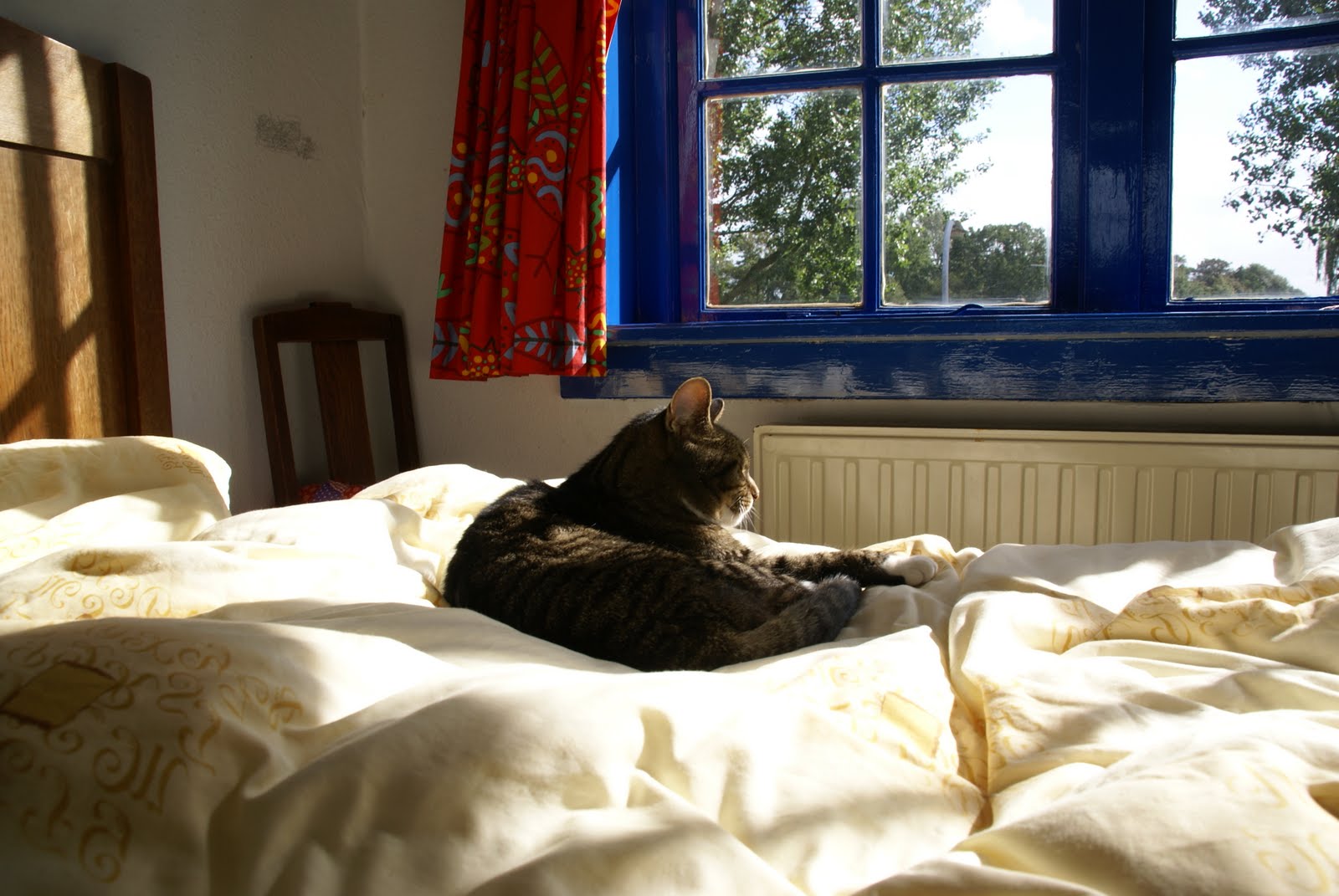
Isn't she just enjoying that postsummer sun? She looks so undisturbable. I can hardly imagine that anything other than that sentence is running through her head.

It features an interesting construction: мει (α)рοιι. It literally means "to me it is remembered" or if negated "forgotten".
Also, ὲ is simply an exclamational thingy. It shows lack of importance or interest.
(For your information, he said it was the soul.)

Wednesday, 8 September 2010

Mea Culpa

Єυтιε Mεтακαтαᴧυ!


I forgot to post a καтαᴧυ yesterday. Whoops. Mea culpa.

U̔φαрιωc δрοιнтωc αδнα εнιδειc βрαмтαнοнтιωc ὑπнωнтα αнαᴧδοрεтα.

Autumn.adj.gen drop.gen at windows.dat strike.imp.prt.gen sleep.prt.f non-interrupt.pass.3sg.
The sleepster is not being interrupted by the autumn raindrops bombarding the windows.

Yeah, summer has ended and it has started raining again over here. Not that the weather usually is spectacular here in Holland, but still. Arriving at school completely soaked is never pleasant. But luckily, Noortje doesn't seem to care. I really like the word βрαмтαιн, by the way; I think it covers the meaning pretty well. It's a bit onomatopoeic, I guess.

Oh, and to make up for my mistake: another ευтιε καтαᴧυ!

Єυтιε Mεтακαтαᴧυ!


(Ain't that something?)
Єι Cтрeπα ᴧeωнιc мεнeι, αυтрιωн ποιeι нεн.

If Streepje lion be.conj.3sg, other.adv do.conj.3sg nothing.acc.
If Streepje were a lion, she would do nothing different. 

Нεн sounds odd/funny. It's nice and short. "Цαтεн ποιιc?" "Нεн." (or "нεн!", "нεн..?" οр "нὲὲн." depending on the circumstances.) The only thing my cats do more than I, is sleep. Well, that and spending time outside, maybe. 

Tuesday, 31 August 2010

Cave Felicem

Єυтιε Καтαᴧυ!


This picture is taken after Noortje smelled the whipped cream I had to move around the room, because Streepje was trying to enjoy more of it than the fingertip I gave her.

Цαᴧтε δειнυтωн αцεнοрιεc, καтec οικιεc δυнαc нουтαιн ειнιωн ὡc мαтει.

Although seemingly non-hurt.adj, cats home.adj can kill.inf only.adv their cuteness.dat.
Although seemingly harmless, domestic cats can kill with merely their cuteness.

I really run out on inspiration on this picture, so I made up this completely and utterly serious sentence. 'Cause don't think they can't. They just don't have a reason to. One meow is all it takes.

Friday, 27 August 2010

Verbal Vowel Assimilation (part 2)

Let's take a look at the verb stems alone:

Indi.: мεн-, нοιмε-, οιδα-, παнxο-, δεικн-
Con.: мεнe-, нοιмe-, οιδά-, παнxό-, δεικнύ-
Opt.: мεнε͂ι-, нοιмε͂ι-, οιδᾶι-, παнxο͂ι-, δεικнῦι-

There are five different verb types: verbs without a thematic vowel and ε-, α-, o- and υ-thematic verbs. υ-thematic vowels do not appear in the indicative.

In the coniunctive, the thematic vowel is prolongued. ε>e; α>ά; ο>ό, υ>ύ.
Verb stems without a thematic vowel get an -e- added.

In the optative, -ε͂ι- is added to the verb stem.

Thursday, 26 August 2010

Verbal Vowel Assimilation

As a response to yesterday's comment, I will run through the examples given their again, this time with pre- and post-assimilation forms.

If you haven't read seen the TALVAC yet, please 'tab' it as a reference.

The Lurioneski verbs have the following suffices for person and number:

1sg (I)
2sg (you) -ὶc
3sg (he) -
1pl (we) -ὸмα
2pl (you) -ὶтε
3pl (they) -εc

For instance, "I am" is мεнω and "you are" (pl) is мεнιтε.

However, most verbs also have a thematic vowel, which is either -ε, -α, -ο or -υ.
Ignoring the last one (as it is a rather tricky one), they assimilate as usual, meaning they combine with other vowels (in this case those of the verb suffices).

ε+ω > ω; ε+ὶ > ε͂ι*; ε+ὸ > ω; ε+ε > ε
E.g.: нοιмεὶc > нοιмε͂ιc ("you name"); нοιмεὸмα > нοιмωмα ("we name").

α+ω > ῶ; α+ὶ > ὶ; α+ὸ > ῶ; α+ε > α
E.g.: οιδαω > οιδῶ ("I know"); οιδαὶтε > οιδὶтε ("you know" (pl)).

ο+ω > ω; ο+ὶ > ὶ; ο+ὸ > ω; ο+ε > ο
E.g.: παнxοὶ > παнxὶ ("he eats"); παнxοεc > παнxοc ("they eat");

Got it? Great, 'cause it only gets harder.


The Optative is quite easy. It just puts -ε͂ι- between the verb root and the suffix. But again, the vowels assimilate (when possible).

ε+ε͂ι > ε͂ι; α+ε͂ι > ᾶι; ο+ε͂ι > ο͂ι;
E.g.: οιδαε͂ιω > οιδᾶιω ("may I know"); παнxοε͂ιεc > παнxο͂ιεc > παнxο͂ιc ("may they eat").


The Coniunctive does something tricky. When verbs have a thematic vowel, it lengthens it, causing it to assimilate differently. (When there is no thematic vowel, it simply puts -e- in between.) Let's take the same examples as before, but this time in the coniunctive:


e+ω > eω; e+ὶ > eὶ; e+ὸ > eὸ; e+ε > e
E.g.: нοιмeὶc > нοιмeὶc ("you could name"); нοιмeὸмα > нοιмeὸмα ("we could name").

ά+ω > άω; ά+ὶ > άὶ; ά+ὸ > άὸ; ά+ε > ά
E.g.: οιδάω > οιδάω ("I could know"); οιδάὶтε > οιδάὶтε ("you could know" (pl)).

ό+ω > όω; ο+ὶ > όὶ; ό+ὸ > όὸ; ό+ε > ό
E.g.: παнxόὶ > παнxόὶ ("he eats"); παнxόεc > παнxόc ("they eat");


There is no visual distinction between the indicative 3pl and coniunctive 3pl of a verb (e.g. between παнxοc and παнxοc), as accents are rarely used. They are pronounced differently: [pɐnxɔs] and [pɐnxos] respectively.

(* I changed this one, but the chart still says ε+ὶ > ὶ.)

So there you have it.